Squalomix
shark genomics and beyond
Achievements
A selection of highlights from our research. For the complete list of our papers, see Publications.
Seeing in the deep blue: the whale shark’s rhodopsin
The whale shark feeds near the sunlit surface, but also dives to depths of nearly 2,000 m. We showed that its light-sensitive pigment rhodopsin is tuned to the blue light that penetrates the deep sea, mainly through a substitution at a single site (site 94) — the very site where a mutation in humans causes congenital stationary night blindness. The substitution makes the pigment less stable at warm temperatures, a trade-off that pays off in the cold deep sea (Yamaguchi et al., 2023). The study was also featured in a news article in Science.
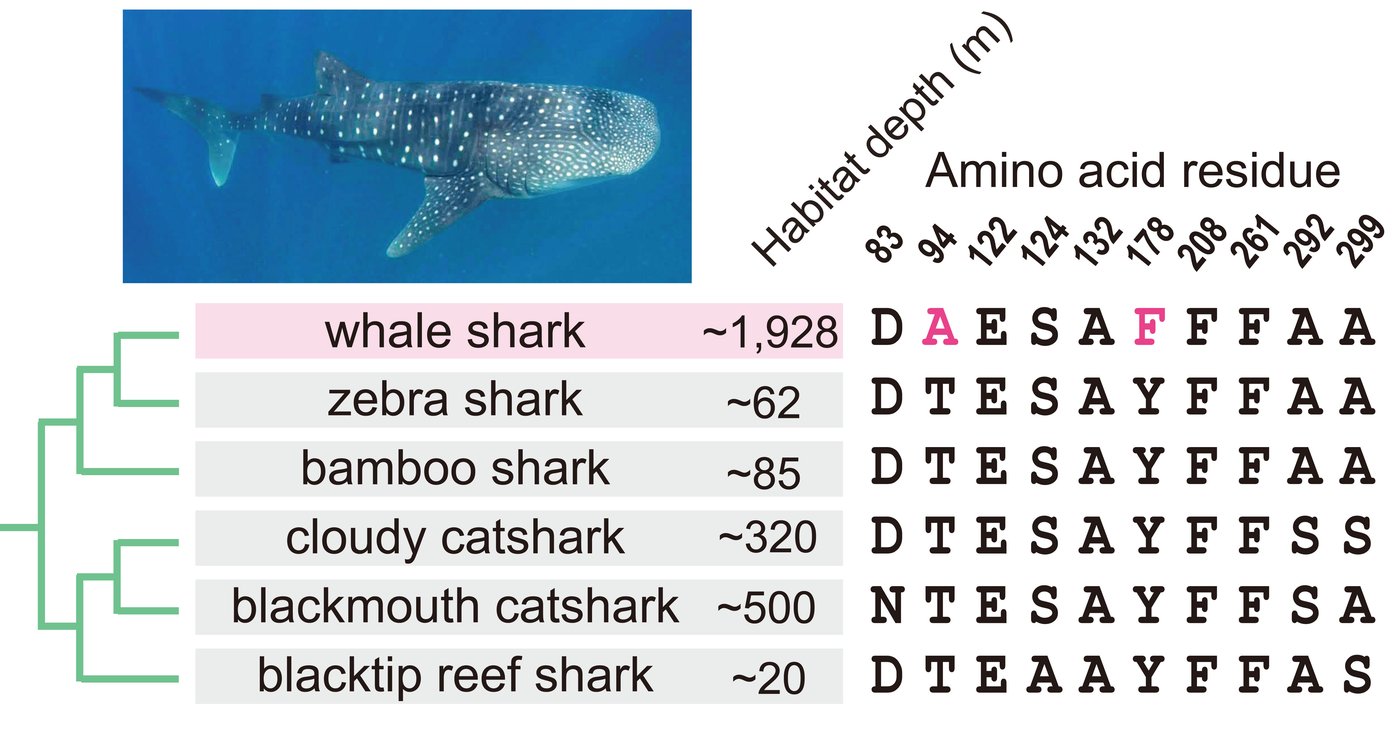
Rhodopsin amino-acid residues in sharks of different habitat depths. The deep-diving whale shark (highlighted, ~1,928 m) carries substitutions at sites 94 and 178 (pink).
Yamaguchi, K. et al. Whale shark rhodopsin adapted to deep-sea lifestyle by a substitution associated with human disease. PNAS 120 (2023). Article
The oldest vertebrate sex chromosome
The sex chromosomes of sharks and rays long resisted analysis. Genome sequencing of the zebra shark and the whale shark yielded the first DNA sequences of elasmobranch sex chromosomes (Yamaguchi et al., 2023), and chromosome-scale assemblies across sharks and rays then showed that they rely on a sex chromosome inherited from their common ancestor — the oldest known among vertebrates, with sex determination mechanisms unlike those of mammals and birds (Niwa et al., 2025).
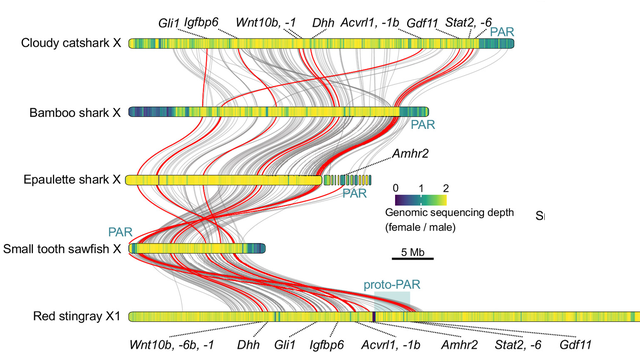
Synteny between the X chromosomes of cartilaginous fishes, with pseudoautosomal regions (PARs) shared at their ends.
Yamaguchi, K. et al. Elasmobranch genome sequencing reveals evolutionary trends of vertebrate karyotype organization. Genome Research 33: 1527–1540 (2023). Article
Niwa, T. et al. Sharks and rays have the oldest vertebrate sex chromosome with unique sex determination mechanisms. PNAS 122 (2025). Article
Dawn of shark genomics
In 2018, we published genome sequences of three shark species — brownbanded bamboo shark, cloudy catshark, and whale shark — together with tissue-level gene expression profiles and epigenomic data on the chromatin regulator CTCF (Hara et al., 2018). Its findings included the slow pace of molecular evolution in sharks, the discovery of the elusive HoxC cluster, and a leptin gene that traces the origin of this hormone back to the jawed-vertebrate ancestor. Produced during our years at RIKEN, this study founded the approach that Squalomix has since scaled up to dozens of species.
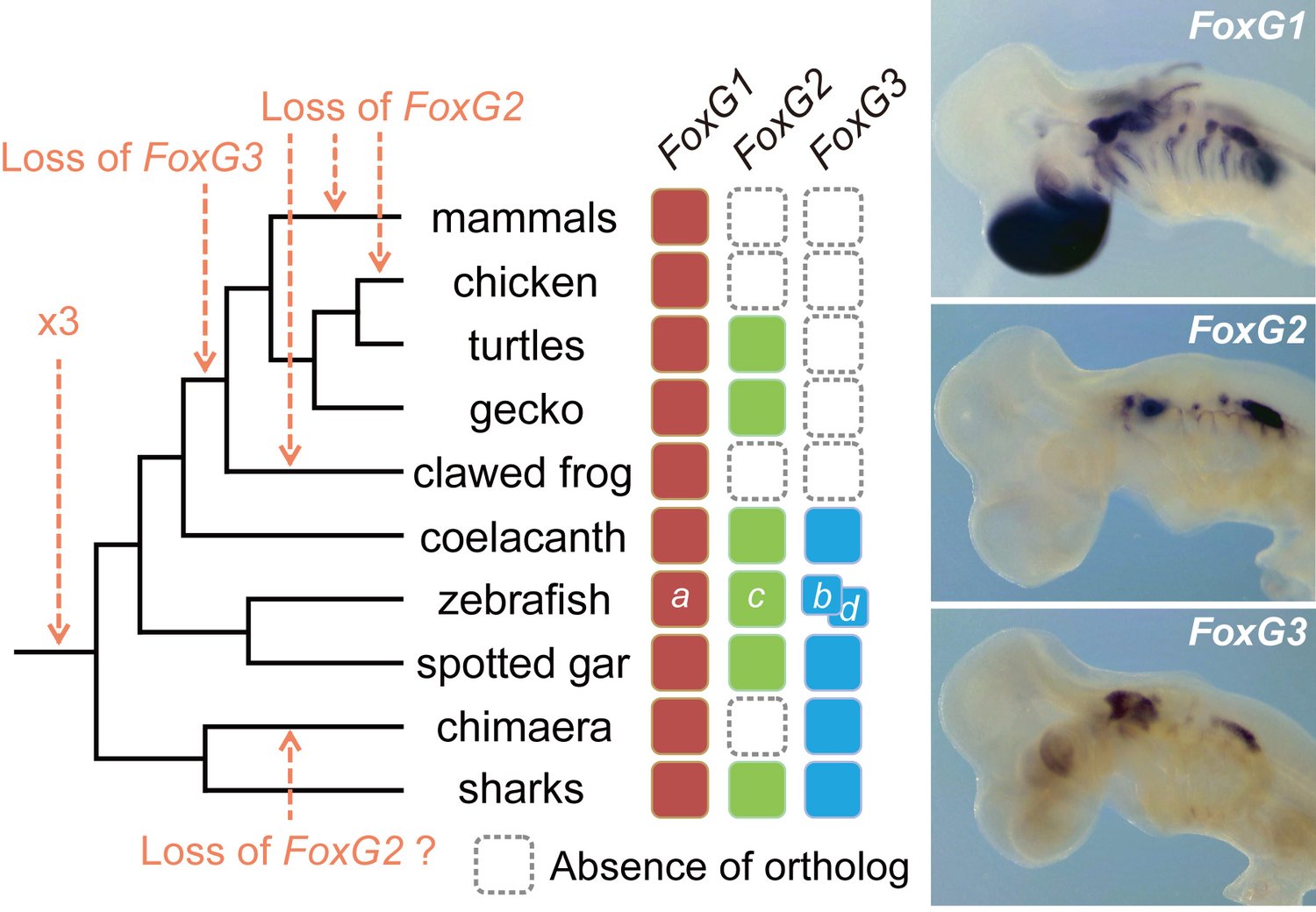
FoxG gene repertoires across vertebrates (left) and FoxG expression in catshark embryos (right), from Hara et al. (2018).
Hara, Y. et al. Shark genomes provide insights into elasmobranch evolution and the origin of vertebrates. Nature Ecology & Evolution 2: 1761–1771 (2018). Article
See also our History.
Yolk proteins repurposed in live-bearing sharks
Sharks reproduce in diverse ways, from egg-laying to live birth in which the mother supplies nutrients directly. Vitellogenins, the yolk proteins that nourish embryos inside eggs, were therefore expected to be lost in live-bearing species. We found instead that their homologs are retained in live-bearing sharks and appear to have been co-opted to nourish embryos in the uterus (Ohishi et al., 2023) — a genomic footprint of the evolutionary shift from yolk-based nutrition (lecithotrophy) to maternal supply (matrotrophy).
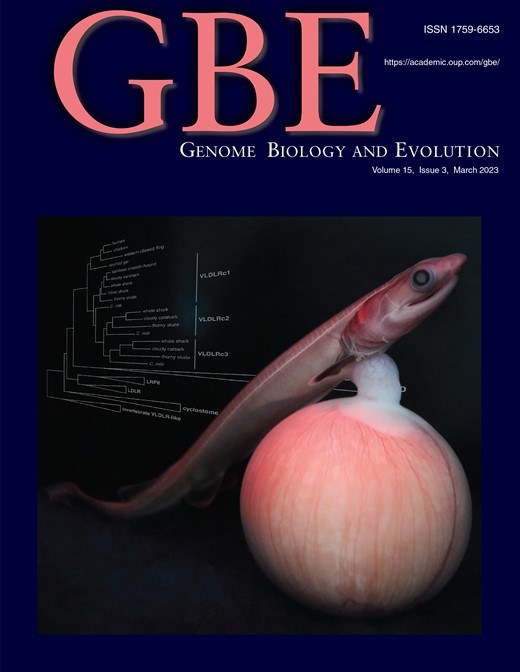
Cover of the journal issue featuring this study (GBE 15(3), March 2023): a frilled shark embryo.
Ohishi, Y. et al. Egg Yolk Protein Homologs Identified in Live-Bearing Sharks: Co-Opted in the Lecithotrophy-to-Matrotrophy Shift? Genome Biology and Evolution 15: evad028 (2023). Article
The study was also featured in the journal’s highlight article, Inside the Shark Nursery: The Evolution of Live Birth in Cartilaginous Fish (GBE 15: evad037, 2023).